
Project Description
Download Loan Management Software Developed Using Firebase and React JS.
Please watch the video to understand it clearly.
After watching the video, you will clearly understand the project and Firebase setup and hosting.
Step 1:
Please watch the video to understand it clearly.
After watching the video, you will clearly understand the project and Firebase setup and hosting.
Step 1:
Download Source Code
Step 2:
Run 'npm install' and then 'npm start'
Step 3:
Create a Firebase account as shown in the video below.
Update Firebase credentials with your details.
These are the modules of the Loan Management Project
Step 2:
Run 'npm install' and then 'npm start'
Step 3:
Create a Firebase account as shown in the video below.
Update Firebase credentials with your details.
These are the modules of the Loan Management Project
Login and Register:
This module allows users to create an account (register) and securely log in to access the system.
Client Management:
A module to store and manage all client information, like their personal details and contact information.
Loan Management:
This helps manage loan details, such as issuing loans, tracking amounts, and keeping records of repayments.
EMI Management:
Tracks and manages Equated Monthly Installments (EMIs), showing due dates, amounts paid, and outstanding payments.
Loan Calculator:
A tool to calculate loan details, like monthly EMIs, total interest, and repayment schedules based on the loan amount, interest rate, and tenure.
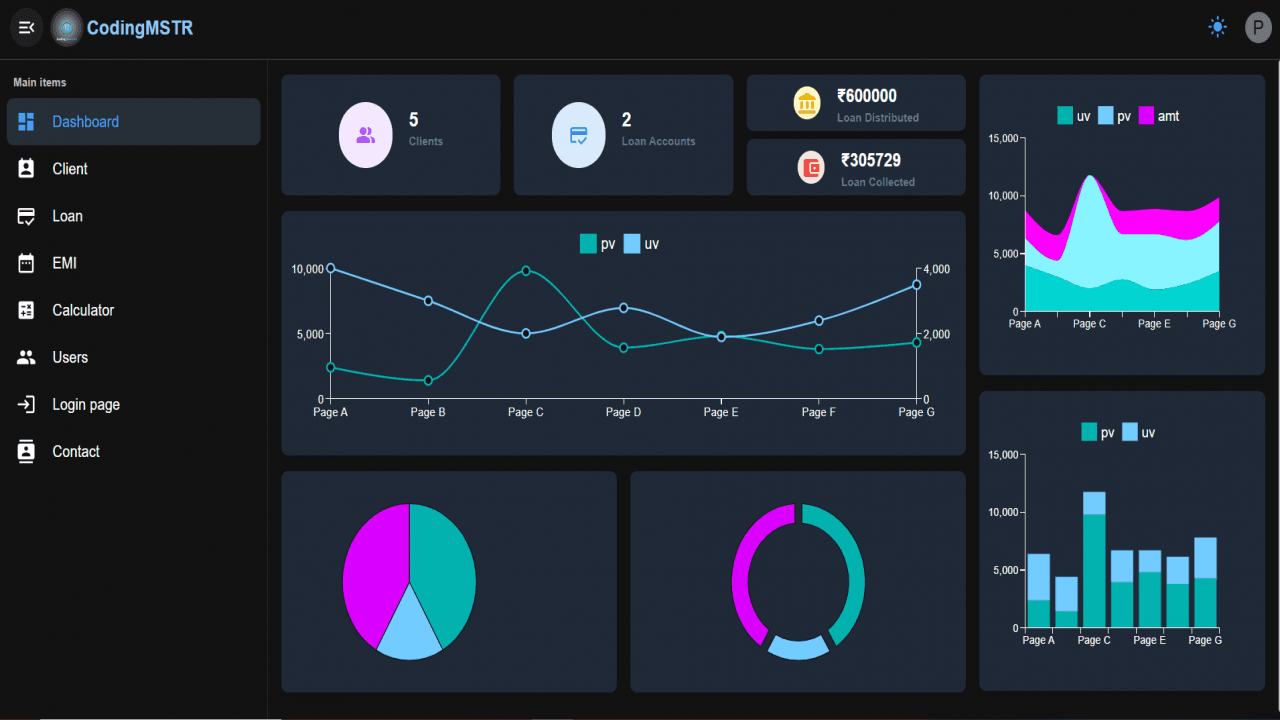
Dashboard:
A visual summary of key data, like the total number of loans, payments collected, and clients, is presented through charts and graphs for easy tracking.
This project comes in dark and light modes.
This project comes in dark and light modes.
Understanding Loan Management: A Comprehensive Overview of Modules and Their Functions
Loan management is a critical process for financial institutions and organizations that deal with lending money. A well-structured Loan Management System (LMS) streamlines this process, ensuring efficiency and accuracy. Below, we explore how each module of a Loan Management Project contributes to the seamless operation of the system.
1. Login and Register
This module is the gateway to the system, ensuring secure access and user management.
Key Features:
Registration: New users, such as administrators, agents, or clients, can create accounts by providing their details, like email, phone number, and password.
Login: Existing users can securely log in using their credentials. The module may include features like multi-factor authentication (MFA) for added security.
Role-Based Access: Different users have different roles (e.g., admin, agent, client), and their access to specific features is controlled accordingly.
Example Workflow:
A loan officer logs in to manage client data.
A client registers to check their loan status online.
2. Client Management
This module maintains detailed records of all clients, serving as the system's central database for borrower information.
Key Features:
Profile Management: Store client details like name, address, contact information, and identification documents.
Search and Filter: Easily find clients based on specific criteria (e.g., name, loan type).
History Tracking: Keep track of past interactions, such as previous loans, EMIs paid, and communication logs.
Example Workflow:
A loan officer adds a new client to the system, uploading their ID and income proof.
The officer updates client details, such as a change of address.
3. Loan Management
This module oversees the core operations of the loan process, from approval to closure.
Key Features:
Loan Creation: Record loan details, including the principal amount, interest rate, tenure, and disbursement date.
Approval Workflow: Automate or manually approve loan applications based on predefined criteria.
Tracking and Reporting: Monitor active loans, pending applications, and repayment schedules.
Example Workflow:
A loan officer creates a loan for a client, specifying the repayment schedule.
The system tracks disbursed loans and flags those nearing default.
4. EMI Management
Equated Monthly Installments (EMIs) are a critical part of loan repayment. This module ensures proper tracking and management of payments.
Key Features:
Payment Tracking: Monitor EMIs paid and outstanding.
Alerts and Notifications: Send reminders to clients about upcoming due dates or overdue payments.
Penalty Management: Automatically calculate penalties for late payments.
Example Workflow:
A client pays their monthly EMI through the system.
The system updates the payment status and sends a confirmation email.
5. Loan Calculator
This tool simplifies complex financial calculations, helping both clients and loan officers understand the financial implications of a loan.
Key Features:
EMI Calculation: Calculate the monthly installment based on loan amount, interest rate, and tenure.
Interest Breakdown: Show how much interest will be paid over the loan period.
Comparison: Allow clients to compare different loan options.
Example Workflow:
A client uses the calculator to estimate their monthly EMI for a $10,000 loan over 5 years at a 7% interest rate.
The tool provides an instant breakdown of the EMI and total repayment amount.
6. Dashboard
The dashboard is the control center, providing a bird’s-eye view of the system's operations.
Key Features:
Key Metrics: Display total loans issued, total EMIs collected, and delinquency rates.
Visual Data: Use graphs and charts to present data for easier analysis.
Customizable Views: Allow users to tailor the dashboard to display metrics relevant to their roles.
Example Workflow:
An admin logs in to view the number of active loans and overdue payments.
A loan officer uses the dashboard to track pending applications.
How the System Works Together
When integrated, these modules provide a comprehensive Loan Management System:
Secure Access: Users log in via the Login and Register module.
Client Setup: Borrowers' profiles are created and managed through the Client Management module.
Loan Issuance: Loans are approved and tracked in the Loan Management module.
Repayment Tracking: EMIs are monitored in the EMI Management module, ensuring timely repayments.
Decision Support: The Loan Calculator assists clients in selecting loan terms.
Data Monitoring: The Dashboard provides a real-time overview of operations, helping in decision-making.
Benefits of a Loan Management System
Efficiency: Automates repetitive tasks, saving time for loan officers and clients.
Transparency: Provides clear communication and tracking of all loan-related activities.
Security: Ensures data integrity and privacy through role-based access and secure login.
Scalability: Handles increasing numbers of clients and loans without compromising performance.
By streamlining loan management processes, this system empowers financial institutions to provide better service to their clients while maintaining operational efficiency.